
A Global Perimeter Detection Standard for a Hyperscale Data Center Portfolio
How IoTHS helped a hyperscale cloud provider turn perimeter requirements into one tested, repeatable detection standard for data centers worldwide.
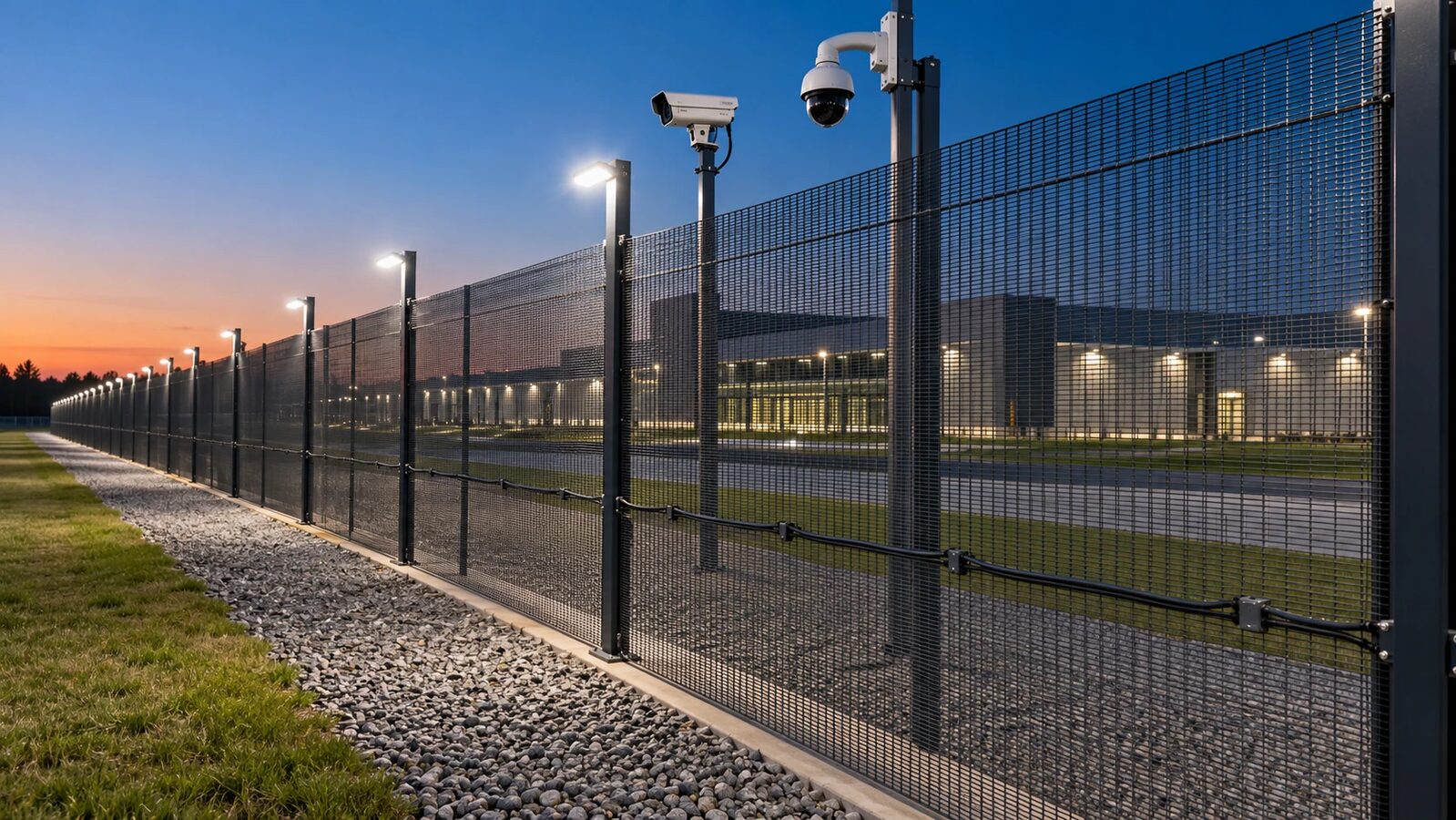
A hyperscale cloud provider asked IoTHS to help put its perimeter requirements into practice across a global data center portfolio. The result is a single, tested perimeter intrusion detection (PIDS) standard: a reference architecture, an installation playbook and an acceptance method that project teams in any region can apply the same way.
At a glance
- Customer: Hyperscale cloud provider with a global data center portfolio across North America, EMEA and APAC
- Scope: Global perimeter intrusion detection standard, hands-on proof of concept, technical and installation playbook, and a regional construction specification
- Platforms: Vendor-neutral; 21 perimeter technologies evaluated, integrated with the customer's existing access control platform
- Timeline: April 2025 to July 2026
- IoTHS services: Advisory and program support, vendor RFIs, proof of concept design and execution, design and engineering, specification writing
The challenge
The customer's data centers had been built by different project teams and integrators, without a unified global perimeter standard. The same threat could be detected one way at one site and another way somewhere else, depending on who designed the fence line and which products they chose.
As part of a global perimeter modernization initiative, the customer wanted to turn earlier RFQ requirements into something every site could follow. The goals were clear:
- Consistent detection performance regardless of region, vendor or site conditions
- Fewer false and nuisance alarms
- One reference architecture instead of many site-by-site designs
- Repeatable installations that leave less to interpretation
- A clear acceptance method, so "done" means the same thing everywhere
- A plan for lifecycle sustainment after handover
What we delivered
Program structure and vendor engagement
The program kicked off in April 2025. IoTHS ran vendor RFI rounds from May through August 2025 and issued milestone templates in July and September 2025, giving the customer a consistent way to track progress.
Hands-on proof of concept
In October 2025, IoTHS ran a proof of concept of about three weeks at an operating data center, on a standalone test network kept separate from production systems. Twenty-one technologies were evaluated, including fence-mounted fiber, accelerometer and microphonic cable, thermal cameras, fixed and 360-degree LiDAR, active infrared beams, deterrent lighting, and PLC and integration platforms.
Test scenarios covered open space, chain link fence, ornamental fence with vegetation, deterrents and active construction. Each technology was assessed on:
- Detection across climb, cut, crawl, approach, breach and bypass attempts
- Nuisance alarms under wind, rain, shadows, wildlife and temperature changes
- Integration with the wider security platform
- Resilience and cybersecurity posture
- Ongoing maintenance burden
Testing was measured against defined probability-of-detection and false-alarm targets, and the POC report followed in November 2025.
A layered detection design
Rather than naming one sensor for every fence, the standard pairs primary, verification and tertiary sensors, with dual-event alarm qualification so that an alarm is confirmed by more than one source. The pairing is chosen by site archetype: clear zone, non-clear zone, construction, ornamental and temporary perimeters.
Technical and Installation Playbook
The playbook was issued in November 2025, with revisions through February 2026. It includes drawing sets, cut sheets, specifications and cyber-hardening guides, plus:
- A sensor selection matrix and alarm verification logic
- I/O integration and integration with the existing access control platform
- Cut and climb test procedures, calibration steps and run sheets
- Semi-annual re-validation and annual firmware recertification
- A two-year rolling maintenance record
Regional construction specification
In July 2026, IoTHS issued a regional Division 28 specification (MasterFormat 28 31 21) for construction at a site in the Asia-Pacific region, along with a 12-sheet drawing set. The specification adapts the global standard to national requirements: electrical safety rules, radio regulations (the base design is wired only), privacy approval before activation, and licensed local electrical work.
How it works today
The standard gives project teams a defined path from design to acceptance. Under the regional specification, acceptance uses an 11-test zone matrix covering detection, cross-zone behavior, faults, tamper, power, communications loss, video, operator workflow, mapping and the end-to-end alarm pipeline. Each installation must also complete a nuisance-alarm soak of at least 14 days before it is accepted.
After acceptance, the playbook's semi-annual re-validation, annual firmware recertification and rolling maintenance record are designed to keep each perimeter performing as intended over its life, not just on handover day.
Who did what
- IoTHS: Program support, vendor RFIs, proof of concept execution and reporting, playbook authorship, and the regional specification and drawing set
- Customer: Program ownership, the operating site for the proof of concept, and approval of the standard
- Regional responsibility matrix: The specification assigns work among the security contractor, the electrical and civil contractor, and the owner or landlord. Electrical work is performed by licensed local electrical contractors, not by the security contractor.
Next step
If your perimeter designs vary from site to site, we can help you build one standard and a clear way to prove it works. Contact us to talk through your portfolio, or learn more about our perimeter solutions and design and engineering services.
Talk to an engineer
Short call, quick requirements pass, and a recommended next step you can act on.
Contact us