
Piloting AI Video Analytics on an Existing Security Platform
How IoTHS piloted Ambient.ai video analytics on a customer's existing Genetec Security Center, adding detection without adding a new screen for operators.
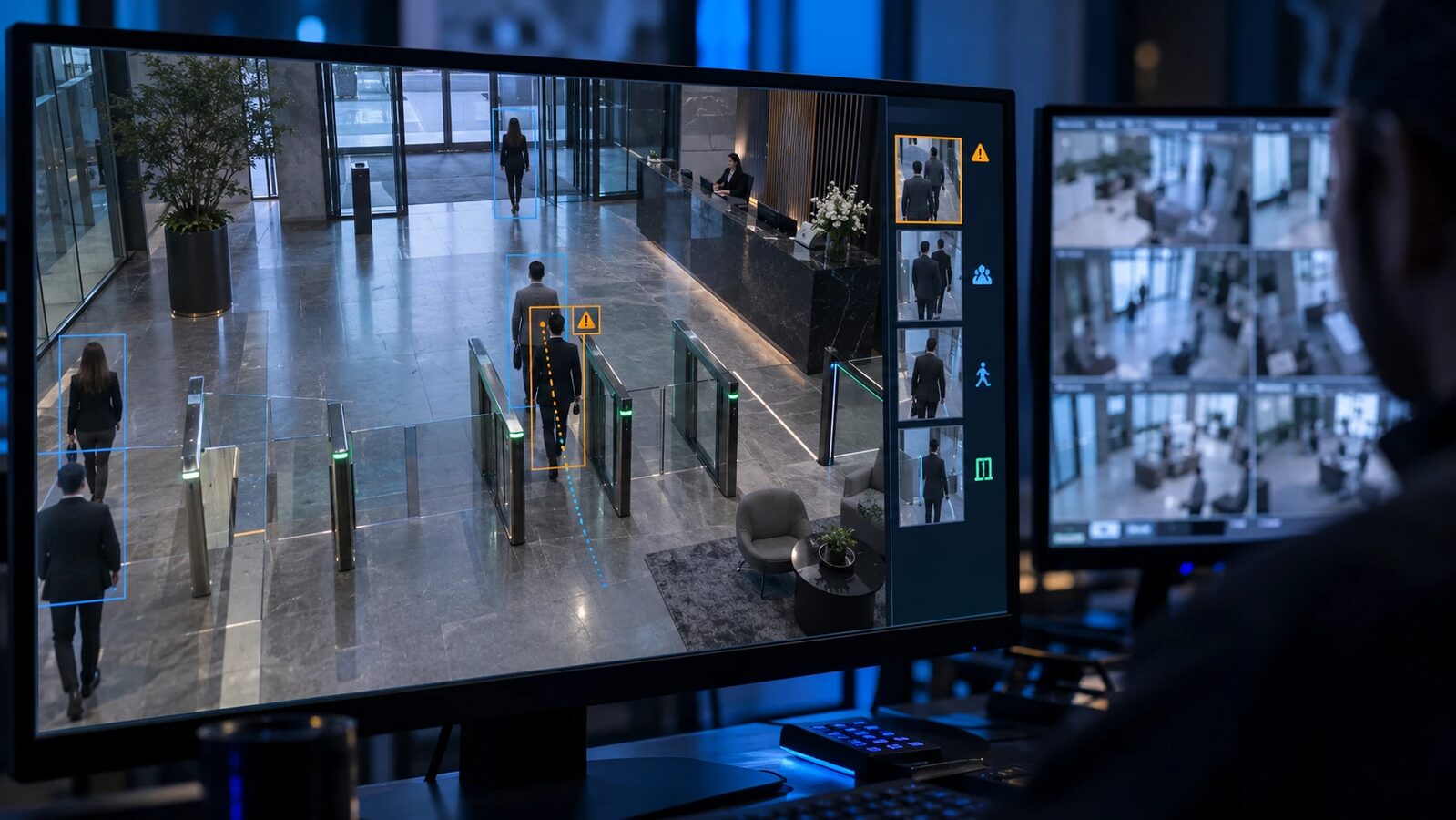
A global gaming and technology company wanted to know whether AI video analytics could make its global security operations center (GSOC) faster and more effective, without replacing the platform its operators already use. IoTHS ran a structured pilot of about five weeks, with Ambient.ai layered on top of the customer's existing Genetec Security Center.
At a glance
- Customer: Global gaming and technology company; headquarters campus with three buildings
- Scope: AI video analytics pilot on nine live camera streams, with two-way access control integration
- Platforms: Ambient.ai as an intelligence layer on Genetec Security Center
- Timeline: December 2025 to July 2026 (pilot June to early July 2026)
- IoTHS services: Pilot design, integration, commissioning, operator training, testing and closeout reporting
The challenge
The customer's GSOC already monitored the campus through Genetec Security Center. The question was whether AI analytics could add value without adding complexity. The pilot needed to prove four things well enough to justify a campus-wide rollout: detection accuracy, fit with operator workflow, investigation value and integration performance.
The use cases under evaluation included:
- Door forced and unauthorized entry
- Reducing nuisance door alarms
- Faster investigations
- Event occupancy awareness
- Overall GSOC efficiency
- Tailgating detection as an alternative to installing more turnstiles
What we delivered
A layered architecture, not a replacement
The analytics ran as an intelligence layer on top of Genetec Security Center, using a temporary edge appliance for the pilot. The integration worked in both directions:
- Into the analytics: Camera streams plus access events from Genetec, including door forced, door held, invalid badge, and access granted or denied
- Back into Genetec: Alerts written into Genetec alarm monitoring, with one custom event per threat signature
Operators worked from the console they already knew. There was no new pane of glass, and the pilot ran alongside existing GSOC procedures.
Coverage and modules
Nine live camera streams covered lobbies, parking entrances, turnstile lines and select interior areas. The pilot enabled foundation, advanced forensics, access intelligence and threat detection modules, with signatures in four groups:
- Access: Unauthorized entry, door forced, door propped, person near an outside door
- Intrusion: Restricted area, crowd forming, tailgating
- Safety: Person falling, brandished firearm, smoke or fire, unattended bag, sudden egress, fighting
- Situational: Unattended desk, animal, emergency personnel
A phased pilot
The pilot followed four phases: Prepare (commissioning, kickoff and operator training), Enable, Operate, and Evaluate (a final business review and decision). Operators received training, a playbook and cheat sheets. Testing ran across day, swing and night shifts, and the GSOC ran blind red-team scenarios to test detection under realistic conditions.
Privacy by design
Detection was based on behavior, not identity. The system did not process identity or personally identifiable information.
Results
- Person-down and turnstile-jump events were detected and classified with zero false positives in the red-team trials.
- Alerts led to a response within the threat-delay window, using the existing detect, verify and dispatch workflow.
- Alerting and GSOC integration met targets end to end.
- Access intelligence automatically cleared forced and held door alarms.
- Natural-language search and appearance-similarity search were demonstrated for investigations.
Not everything worked on day one. Some detections needed tuning or vendor remediation during the pilot and were re-tested. Nuisance alarm reduction could not be quantified at this site, because the pilot doors were quiet during the test period.
At closeout in July 2026, IoTHS recommended a business value assessment and production scoping as the next step, including extending coverage to the readers that generate the most alarms. The pilot equipment was decommissioned, with proof of data deletion provided to the customer.
Who did what
- IoTHS: Pilot planning, integration with Genetec Security Center, commissioning, operator training materials, test coordination and the closeout report
- Ambient.ai: The analytics platform and remediation of detections that needed adjustment
- Customer GSOC: Operated the pilot alongside existing procedures and ran the blind red-team scenarios
- Existing platform: Genetec Security Center remained the system operators used for alarms and access events
Next step
A well-run pilot answers the questions that matter before you commit to a rollout. Contact us to plan yours, or read more about our pilot services and our work with Ambient.ai.
Talk to an engineer
Short call, quick requirements pass, and a recommended next step you can act on.
Contact us